For a small jewelry business, finding the right custom gemstone jewelry supplier is very important. This choice affects your product quality, profit margins, and branding. Retailers who use middlemen often see lower margins because of added costs. Direct sourcing from manufacturers gives better returns—wholesale models have 25% to 45% gross margins, and direct-to-consumer brands get 55% to 70%. An order contribution analysis shows that a direct-sourced item can earn 26.7% of revenue after costs. But the real challenge is finding a partner who understands your design vision and delivers consistently. This step-by-step guide walks you through the process—from defining your niche to negotiating exclusivity—so you can check suppliers, judge quality, and get good terms with confidence.
Decide what makes your business special and what prices you will charge. This helps you find the right customers and suppliers.
Pick manufacturers instead of middlemen to raise your profits and make production faster.
Check the quality and certificates of the gemstones to protect your brand and customers.
Know the shipping costs and payment terms so your business stays profitable.
Talk about exclusive rights and long-term contracts to protect your designs and help your business grow.
Before you talk to any supplier, you need to know your niche. A small jewelry business cannot sell to everyone. You need a clear style, like simple, boho, fancy, or another look. This focus cuts down your choice of suppliers a lot. A simple brand needs neat lines and few gems. A boho brand needs natural shapes and bright colors. Your niche also shapes your brand and how you market. When you know your niche, you can build a website that speaks right to your customers.
Who you sell to sets your prices. Younger buyers often want trendy designs that earn good profit and they can wear daily. They shop online and react to strong online ads. You need to know how much they will spend. This knowledge helps you talk to suppliers. A supplier who cannot match your price will cut your profit.
Your price also affects what materials you pick. Gold costs more than sterling silver. Platinum costs more than gold. You need to balance quality and cost. A clear price helps you avoid wasted samples and bad orders. It also helps you plan ads that reach the right buyers.
You need to know your customization choices before you call a supplier. What gems do you need? What metals? What setting styles? The jewelry market has many options. A bezel setting works well for active people. A pavé setting makes a piece look bigger. A channel setting protects gems well. You should also pick your metal type. Yellow or rose gold adds warmth to moissanite. White gold gives a cooler shine. Platinum prongs are very strong.
These details are important when you make your jewelry. A supplier who cannot make your design will waste your time. You need a partner who gets your special needs. Write down what you need. Include gem types, metal types, and setting styles. This list becomes your checklist when you look at suppliers.
Once you know your niche, you can begin to find the right partner. The world jewelry market has many options. Each option changes your costs, quality, and how fast you get to market. You need to look at your choices carefully.
You will find three main kinds of suppliers: manufacturers, wholesalers, and trading companies. Each kind has a different job. A wholesaler buys ready jewelry and sells it again. A trading company works as a go-between for you and a factory. A manufacturer makes the jewelry itself.
For a growing small jewelry business, manufacturers often give the best deal. They let you customize more and offer good prices. Working directly with custom jewelry manufacturers cuts out extra steps. Each step adds cost. When a piece goes through four steps to reach a store, the store pays almost 50% more than the factory price. That extra cost comes from middlemen, not from skill, gold, or design.
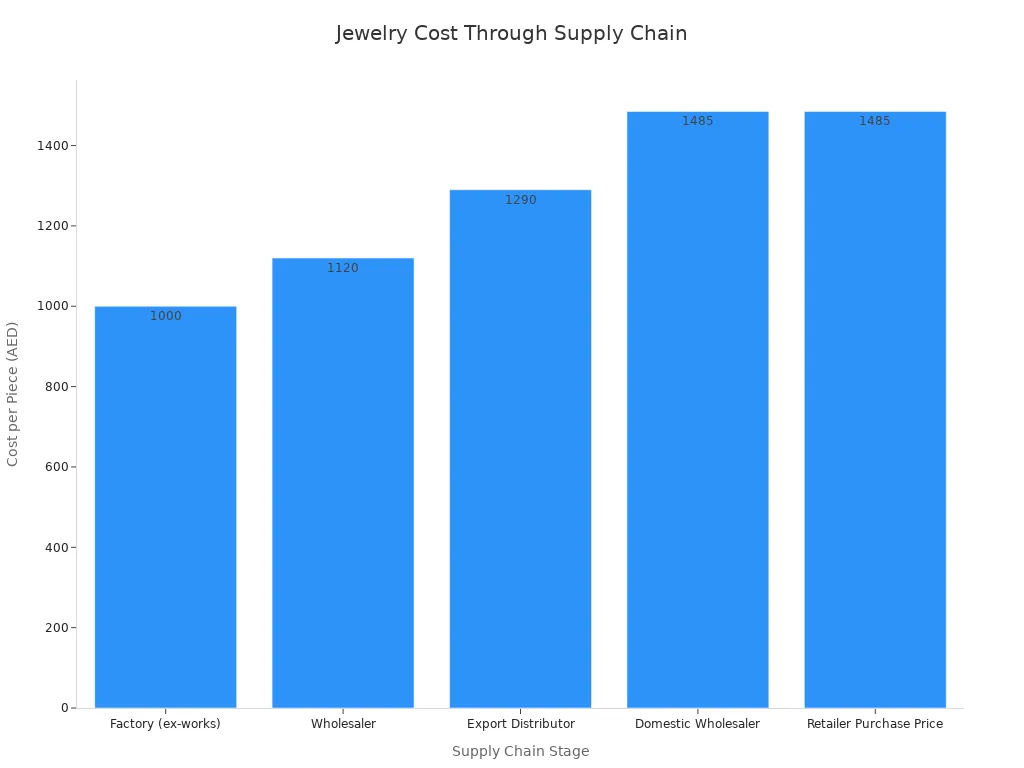
Buying direct changes your numbers. Stores pay only the factory price, usually 15–30% less than going through a distributor chain. Your profit margin goes up by 8–15% on items you buy direct. You also get faster production: direct maker lead times are 2–4 weeks for catalog items and 4–6 weeks for custom orders. With middlemen, it takes 8–12 weeks. Your own brand pieces can sell for 20–40% more because no one else sells the same thing.
"Buying direct gets rid of middleman costs that usually add 20 to 50 percent to a piece's price by the time it gets to a store. Direct sourcing also lets you get custom designs, check quality at the factory, get faster production, and build a long-term partnership with your supplier."
You get more than just lower prices. Direct custom jewelry manufacturers let you check quality at the source. Problems go right back to the shop that made the piece. You get replacements or refunds without blaming different people. You also keep your brand safe with unique designs. Low minimum order amounts let you try designs before making many. This cuts your inventory risk and helps you sell faster.
You can find suppliers in a few ways. B2B websites let you reach many companies. Recommendations from other brands give you trusted suppliers with good history. Trade shows are still the best way to meet professional custom jewelry manufacturers in person.
Trade shows keep you up to date on industry trends. You can feel the stones, look at the settings, and talk to the makers. Big events include AGTA GemFair Tucson, the JOGS Tucson Gem & Jewelry Winter Show, JCK Las Vegas, and JIS Spring in Miami Beach. Each show brings different companies and buyers.
Location | Dates | Relevance to Sourcing Custom Gemstone Jewelry Suppliers | |
|---|---|---|---|
Plumb Club (co-located with JCK) | Las Vegas, NV | June 5–8, 2026 | Invitation-only area with top US and world makers; good for meeting custom jewelry makers who can do special large orders with clear supply chains. |
AGTA GemFair Tucson | Tucson, AZ | Feb 2–6, 2026 | Top market for colored gems and pearls; brings top gem sellers and world buyers; focuses on honest sourcing and quality stones. |
You must check quality before you commit to a custom gemstone jewelry supplier. A smooth sales pitch cannot replace a hands-on inspection. This step protects your brand and your customers.
Start with the metal. Fine jewelry carries a hallmark that states its purity. Avoid pieces labeled gold-plated or gold-filled when you want lasting value. You can confirm sterling silver with several tests.
Test | Description | Type |
|---|---|---|
Acid test | Nitric acid applied to a scratch; sterling silver turns cream, lower metals turn green | Professional |
Electronic (XRF) | X-ray fluorescence measures metal composition without damage | Professional |
Density test | Measure weight and volume | Professional |
Magnet test | Silver is non-magnetic; strong attraction indicates ferrous metals | DIY |
Ice test | Silver conducts heat rapidly; ice melts quickly on genuine silver | DIY |
Sound test | Tapping produces a distinct ringing sound; dull thud suggests fake | DIY |
Visual inspection | Check hallmark crispness and color (white-gray, no brassy undertones) | DIY |
Weight and feel | Sterling silver feels substantial; light pieces may be plated | DIY |
Gemstone treatments also affect value. Heating enhances color and clarity in sapphires and rubies. Oiling fills surface fractures in emeralds. Dyeing adds vibrant hues to agate or jade. Laser drilling removes inclusions in diamonds. Treated stones may be valued lower than untreated ones, so always ask for disclosure. Untreated natural stones often sell at a premium.
Excellent craftsmanship shows in every detail. Run a fingertip over the stones. Loose or uneven settings signal poor work. Hold the piece to your ear and shake it gently. A rattling sound means a loose stone. Check that prongs grip evenly without covering the gem. Bezel settings should fit snugly with no gaps. Flip the piece over. The underside should look clean and polished, not rough. High-quality metals feel substantial and smooth. Look for uniform polish, symmetrical settings, secure clasps, and clean solder joints. A GIA or IGI certificate documents cut, color, clarity, and carat grades independently.
Ask how the supplier inspects incoming materials, sorts and matches stones, and performs final inspection before shipment. Reliable partners document your specifications and use standardized sorting procedures. This discipline helps them source materials that meet your standards every time. When you evaluate a custom gemstone jewelry partner, treat these checks as non-negotiable.
You have checked the quality and chosen a supplier. Now you need to manage the costs that come after the jewelry is made. Shipping and payment terms decide your final profit. A low unit price does not matter when shipping fees and duties eat into your margin.
Minimum Order Quantities (MOQs) protect the factory. They also limit your cash flow. Ask for a small trial order first. Many suppliers lower the MOQ once they trust your business. You can also work out a mixed order with several designs to meet the minimum.
Payment terms follow a clear pattern in this industry. Sample orders usually need full payment upfront. Production orders split into a deposit and a balance.
Order Band | Deposit | Balance Term |
|---|---|---|
Sample / Prototype | 100% in advance | N/A |
Small Wholesale | Remaining 50–70% before shipment | |
OEM / Private-Label | 30–50% T/T | Remaining 50–70% before shipment |
For new buyers, sample-only orders are usually 100% payment in advance. For small wholesale and OEM/private-label orders, we generally use a 30–50% T/T deposit and the balance before shipment.
Pay by bank transfer or Wise. Save PayPal for low-value samples where you cover the platform fees. Never pay the full balance before you check the goods.
Incoterms 2020 explains who pays for what. DDP (Delivered Duty Paid) puts almost all import risk on the seller. Your jewelry arrives with no extra charges. DAP (Delivered At Place) moves duties to you, and carriers may collect a handling fee before delivery. FOB and CIF work for sea freight, which rarely fits high-value jewelry.
Air freight is common for jewelry shipments, with rates varying by destination and service level. Transit times depend on the route. Your supplier should give you a commercial invoice, packing list, bill of lading or AWB, and a certificate of origin.
Know these costs before you sign. They protect your marketing budget and keep your online store profitable.
You should always ask for a sample before you place a big order. This step lets you check the stones, the metal finish, and the setting work. A sample also shows how well your custom gemstone jewelry supplier follows your instructions. The process typically includes design consultation, CAD modeling, wax model review, casting, stone setting, polishing, quality control, and shipping. Clear communication stops costly mistakes. Use email for detailed specifications and record keeping. Use phone calls for urgent clarifications. Schedule video calls when you need to talk about complex design changes with visual aids. Chat apps like WhatsApp work well for quick, informal updates. Match the channel to the task. Complex designs need visual tools. Time-sensitive issues need immediate contact.
Exclusivity protects your branding. You do not want your best-selling design showing up in a competitor's store. Ask for a written exclusivity agreement with your custom jewelry manufacturers. Cover four key terms: design ownership, how long exclusivity lasts, sales volume requirements, and exit conditions. Negotiate a separate design fee so both sides understand you are paying for exclusive rights. Or you can require that exclusive designs are made only by the original maker.
A strong contract also includes protective clauses. Manufacturing agreements define the scope of work, exclusivity, quality standards, and design ownership. Non-disclosure agreements protect confidential information you share during the sampling stage. Licensing agreements specify royalties, territory, and duration for any third-party use of your designs.
Think of your supplier as a strategic partner, not just a vendor. A partner helps you design your jewelry around current trends. They support your marketing and branding goals. They also help you scale custom-made creations without sacrificing quality. Start with a small trial order. Build trust. Then negotiate long-term terms that support your business growth.
You now have a clear plan for picking a custom gemstone jewelry supplier. Get ready first. Know your niche, price range, and design needs. Then check suppliers. Compare types, look at quality, and ask for certificates. Finally, make a deal. Agree on minimum orders, payment terms, and exclusive rights.
The right partner is a helpful teammate, not just a seller. They boost your brand and help you create a marketing plan that works for your customers. A good supplier also supports your online ads and keeps your store full of items people want.
Start small. Order samples before you buy in big amounts. This step protects your business and builds trust.
Start your search today. Make a list of jewelry makers and ask for price quotes. Your next great jewelry line begins with the right partner.
Production lead times for custom orders are typically 4–6 weeks, with catalog items taking 2–4 weeks.
Yes. Manufacturers often give exclusivity deals for a minimum order amount or a separate fee. Talk about design ownership, territory, and duration in writing. This keeps your brand identity safe.
Ask for a sample before you place any big jewelry order. Check gemstone settings, metal purity, and finish. Look for certifications that ensure quality and ethical sourcing. A written process helps keep quality the same.
Sample orders need full payment upfront. Production orders split into a 30–50% deposit with the rest due before shipment. Use bank transfer for large payments.


 EN
EN
 English
  Italian
  Spanish
  Ukrainian
  Japanese
  Norwegian
  Portuguese
  Korean
  Russian
  French
  Danish
  German
  Arabic
  Back to List