You pick the best Jewelry CAD team for concept realization to bring your ideas to life by checking their factory knowledge, design history, communication habits, and production fit. Pretty digital pictures often fail during metal casting, stone setting, or factory making if the CAD models miss exact structural measurements. Weak metal claws and wrong shrinkage math lead to expensive wasted metal and extra fixing work.
A skilled technical team prevents expensive factory delays, cuts down on wasted materials, and ensures your designs turn out right. Exact 3D design files boost your total jewelry quality before real metal casting even starts. Also, dependable partners streamline your entire jewelry making process from the first drawing to the final shine. You shield your business budget and keep product quality steady throughout every new product line.
Select a CAD team with real factory experience to avoid expensive casting errors.
Pick all-in-one jewelry makers to make creating pieces easier from sketching to final smoothing.
Try printing cheap resin 3D models before making expensive metal test pieces.
Check the right metal shrinkage rates so gemstones fit correctly after casting.
Pay for a small test project to check a designer's CAD abilities and how fast they reply.
Turning your creative ideas into real items requires finding a suitable working model. Your choices will directly shape project budgets, work reliability, and future growth potential. To pick a great jewelry cad team for concept realization, you should compare freelancers, specialized agencies, and full-service factories carefully. Each option brings specific advantages to growing jewelry businesses aiming for steady expansion. You must weigh basic software costs against future business goals while planning your daily operations.
Freelancers provide handy extra help whenever you start making custom pieces. This choice means paying strictly for finished tasks while avoiding software fees or official worker benefits. Even so, product standards change a lot among separate contractors since their personal talents differ. Specialized agencies offer steady visual styles along with better testing procedures for every project. Their internal technical staff protects your secret files, answers questions much faster, and keeps private design files safe.
Aspect | Freelance Model | Specialized Agencies |
|---|---|---|
Cost | Lower rates per individual project | Higher fixed operational overhead |
Flexibility | Rapid capacity scaling per project | Less flexible short-term capacity |
Communication | Potential time-zone feedback delays | Smooth real-time team collaboration |
Quality Control | Varies by individual talent level | Standardized quality assurance steps |
Jewellery is the fastest way to see whether somebody can actually model: small geometry, difficult materials.
Always review real factory records when checking new workers to confirm their true building experience. Choosing a jewelry partner with proven technical skill across many product types brings you big advantages. Make sure their older cad files turned into real metal items without casting mistakes, tiny holes, or weak spots.
All-in-one factory partners stop mixing up instructions between distant design teams and factory builders. Merging creative work with factory making connects basic drawing setups, digital cad modeling, mold creation, gem finding, and final manufacturing into one smooth path. Working this closely together stops costly mistakes while building your first test pieces.
Product Planning: Factory experts check if items are easy to build, set size limits, and confirm final dimensions early on.
Digital Engineering: CAD workers create shop-ready 3D models tailored specifically for easy gem placement.
Prototype Development: Casting workers change accepted 3D files into real plastic or wax molds for testing.
Mass Production: Experienced workers craft whole store orders while watching product quality very carefully.
Full-service manufacturing partners, like Perfect Jewelry, smooth out your complete idea-to-product path. Their skilled crew combines jewelry design, sample creation, metal sourcing, and factory making inside one easy system. This smooth setup cuts wasted metal, speeds up delivery dates, and maintains exact sizes across big factory runs. You get strong technical help while expanding your complete product catalog. Using one combined factory network keeps your original design ideas safe from first drawings to final boxes. Picking a skilled jewelry cad team for concept realization guarantees quick work and smooth factory production for every new collection. Exact CAD files bring steady results through every phase of making your jewelry. Your business achieves fantastic store success when product planning combines smart design help with complete factory supervision. Partnering with a full-service factory gives your brand total command over production schedules, metal quality, and final output standards. Following this organized method helps you earn buyer trust day after day.
Every 3D model needs exact structural setup for jewelry manufacturing. Visual looks are simply not enough. Natural steps like casting and polishing change metal sizes as you work. A complete jewelry model must fit the true limits of shop tools. Standard cad software shows perfect digital pictures on your screen. In real life, metal shrinks, shifts, and softens as workers handle it. Because of this, skilled technicians tweak sizes for 3D printing, casting, polishing, and bench assembly. Even wall thickness stops shape changes while the metal cools. Adding tight measurements everywhere raises factory costs fast. So, staff use strict limits only when a part needs exact fitting. Strong structural thickness stops bending during vacuum casting. Proper tool clearance lets bench workers sand, polish, and set gems easily. Clean digital geometry lets team members update files quickly.
Digital renders give a false feeling about real jewelry items. Zooming in on a screen twists true sizes. A cad model looks thicker on purpose because bench jewelers trim claws, edges, and surfaces during finishing. A real prototype shows true tool space, skin comfort, and total strength.
Discrepancy | Cause in CAD | Actual Cast Result |
|---|---|---|
Bulkier appearance | CAD files include extra metal for polishing loss | Finished ring appears finer and more delicate |
Large square claws | Extra metal allows secure gemstone setting | Claws become elegant shapes after finishing |
Sharp rough edges | Model represents unpolished raw metal | Polishing removes excess metal and smooths surfaces |
You need to print a plastic resin sample before buying pricey metal test pieces. Resin jewelry models cost far less than finished metal castings. You can quickly check seat depth, prong height, and metal space on resin models. Sending written notes helps guide file updates well. Checking physical sizes against original cad specs stops late fixing work. Divide complex items, like big halo earrings, into separate parts for smooth assembly. Bad quality checks and extra fixes cost shops 5% to 35% of total making costs. Early prototype testing protects your schedule, budget, and custom jewelry design vision.
Metal physics sets size rules before factory work even starts. Hot liquid metal shrinks as it cools into solid shapes during casting operations. You must shift digital settings based on how each alloy acts during jewelry production.
Jewelry Metal | Casting Shrinkage Tolerance (%) |
|---|---|
Gold (Jewelry alloys) | 1.2 – 1.5 |
Sterling Silver (925) | 1.5 – 2.0 |
Platinum | 2.5 – 3.0 |
Brass / Bronze | 1.5 – 2.1 |
Gems also come in slightly different sizes across various factory batches. Standard cubic zirconia stays close with a tight size limit of ±0.02 mm. Real natural stones change up to ±0.05 mm. Because of this, stone seats need a snug fit 0.05 mm to 0.12 mm wider than true gem sizes. Skilled setters check tool angles and prong space before placing any gems. Good prong spacing stops stones from hitting each other and breaking. You must scale resin printing models up by 0.5% to 1% to match resin and metal shrinkage. Adding tiny drain holes under stone bases clears out liquid resin and stops trapped air during jewelry manufacturing operations. Smart technical design plans for real rules, boosts custom design accuracy, and stops stone damage. These extra steps protect overall piece design integrity through complete jewelry creation.
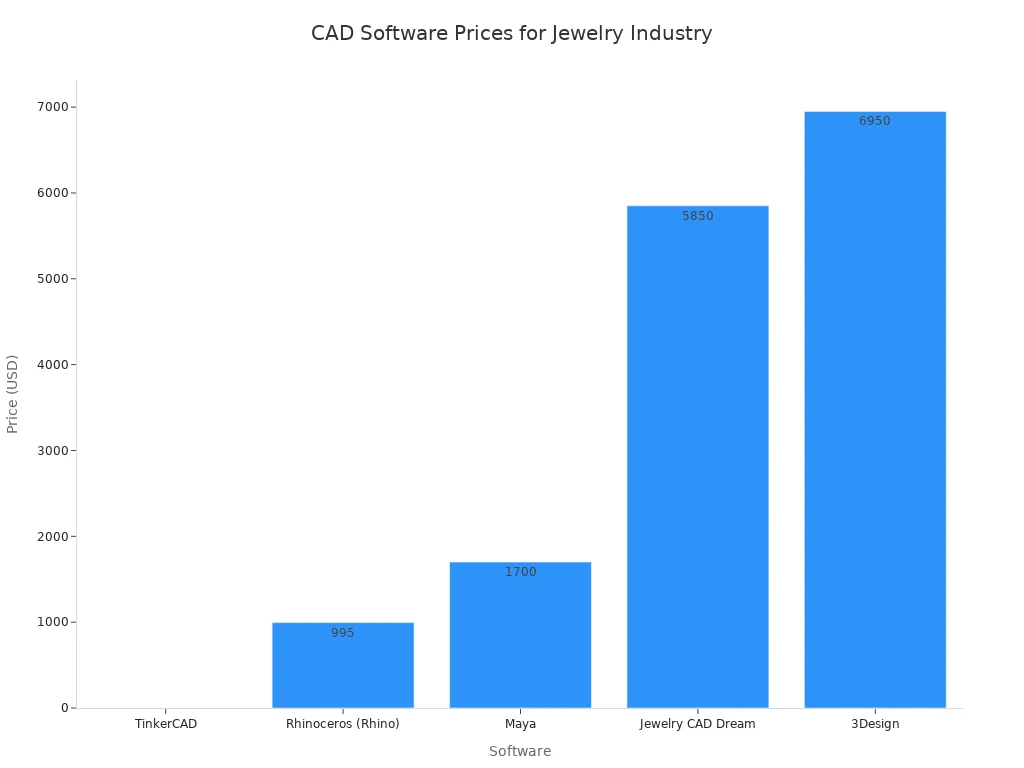
You must check your cad team's software skills with care. Professional artists choose specific tools based on geometry needs, special features, and overall software prices. Rhinoceros costs about $995 once, offering powerful tools for tricky surface modeling. In contrast, 3Design costs near $6,950 for special features like gemstone placement arrays. Jewelry CAD Dream runs around $5,850 and handles complex models with over 500 gemstones easily. Meanwhile, Maya costs roughly $1,700 yearly for natural organic patterns.
Top technical teams keep at least 5 years of jewelry design experience using Rhino or Matrix. Skilled workers fully understand surface fix methods and complete jewelry production steps. They turn creative ideas into exact master files while controlling custom jewelry modeling settings accurately. Fitting your technical needs to jewelry industry standards ensures dependable factory results.
Production Stage | Required/Primary Formats | Key Standards & Requirements |
|---|---|---|
3D Printing | STL, 3MF, OBJ | STL: Export at high resolution with 0.01mm tolerance or better. |
Final Manufacturing | STEP, 3DM, IGES | STEP (ISO 10303): Industry standard for precise geometric data exchange. |
Perfect 3D printing needs clean shape math and careful file preparation. CAD workers check models for non-manifold edges, open mesh holes, and overlapping points before printing. Flipped normals confuse slicing software and create big physical building flaws during jewelry casting work. Also, unit errors during file export ruin precise physical ring sizes.
Your production team must fix overlapping shapes to guarantee successful metal casting. Unfixed gaps stop printer software from finding inside edges correctly. Very thin walls make physical parts collapse during resin printing of complex design parts. Master workers add needed sprues and support setups straight to original files. These smart technical steps shield your jewelry business during real casting runs. Skilled CAD experts turn your main jewelry design vision into perfect jewelry pieces reliably for fine jewelry manufacturing.
Clear talk schedules keep your custom jewelry project moving fast. Simple design jobs usually take 24–48 hours to finish. Tricky jewelry models need 3–5 days based on shape details and fix cycles. Quick message steps help your team make fast model changes. Fast chats speed up design approvals between your brand and CAD artists.
Digital design steps cut sample creation times compared to old hand tools.
Method | Typical Lead Time (prototype) |
|---|---|
Traditional hand-carved master | 7–21 days |
CAD + SLA 3D printing | 1–5 days |
CNC machining | 3–10 days |
Silicone molds + urethane casting | 3–7 days |
Most simple designs are completed within 24–48 hours. Complex pieces may take 3–5 days depending on detail and revision cycles.
You save good business time using smart 3D setups for fine jewelry creation. Fast model fixes help you launch whole lines on schedule.
Safeguarding original jewelry design files needs strong safety tools during online teamwork. Your factory team must guard every jewelry CAD team for concept realization file.
Encryption: Keeps cad files safe while moving through webs and sitting inside folder drives.
Access Controls: Limits system entry to approved staff so random people cannot view your files.
Watermarking: Stamps owner tags on screens to stop bad picture sharing and trace leaks.
Audit Logs: Tracks user file history to show who opened every document and when.
Legal papers protect your full design rights for every custom jewelry piece. Ask a legal expert to write cross-border rules that clearly protect your private cad models, drawings, and shop notes. Your factory deal must include exclusive terms that stop shops from making your items for other buyers or using your molds. A loyal jewelry partner keeps your work safe. Protected company servers keep private client files secure. Partnering with a reliable jewelry factory shields your creative work from early sketches to final store boxes.
A paid trial task lets you pick a great jewelry CAD team for concept realization. Send new applicants a hard practice assignment featuring tight pave prongs, proper draft angles, and exact stone seats. This real-world test proves if artists can truly turn tricky ideas into strong, factory-ready items.
Set clear scoring rules before launching your main trial project. Reviewing candidate 3D files with careful grading steps keeps your company safe from expensive shop mistakes.
Evaluation Criterion | Validation Focus for Benchmark |
|---|---|
Stone seat depth and fit | Check if the gemstone sits correctly and securely in the CAD model. |
Prong thickness and structure | Verify prongs are thick enough to hold stones without breaking. |
Wall thickness and weight feasibility | Ensure walls are not too thin for casting and weight is realistic. |
Clasp and hinge design strength | Test the structural integrity of functional components. |
Sharp-edge risk | Identify any areas that could cause discomfort or injury. |
Wearability and comfort | Assess if the design is practical for everyday use. |
Tolerance expectations | Define acceptable dimensional deviations for finished pieces. |
When you get the final digital files, print plastic resin samples to check key technical areas. You should examine total cad surface flow, smart metal weight balance, and clean metal casting steps. This check guarantees easy jewelry manufacturing without any broken parts.
Measure your plastic sample against tough shop rules before starting big factory runs. The chart below shows critical sizes for your team to check:
Production Aspect | Standard / Guideline |
|---|---|
Minimum wall thickness (small pieces) | No less than 0.7 mm |
Minimum wall thickness (large pieces) | No less than 1.0 mm |
Through holes | Diameter no greater than 0.7 mm; larger diameters can have longer lengths |
Unsupported hole depth | No greater than 0.35 mm |
Lettering width (narrowest part) | No less than 0.5–0.7 mm |
Lettering depth (inset) | No deeper than 0.35–0.4 mm |
Prong thickness (micropave) | No thinner than 0.5 mm |
Prong height from girdle (small stones 2–4 mm) | Add about 1 mm extra length |
Scaling for production | Scale up 3–5% depending on process and metal |
Cleanup allowance | Add about 0.1 mm to finished measurements |
Smart design checking saves big money during large shop runs. Double-checking every detail guarantees high jewelry quality for every item you make. Experienced workers fix tiny jewelry design details to shield your creative style.
Selecting the right jewelry cad team for concept realization protects your overall brand capital and workflow. You must evaluate true structural accuracy long before ordering mass production.
Follow this simple evaluation checklist to choose your ideal partner:
Assess physical casting samples instead of visual digital renders.
Verify software proficiency alongside exact cad tolerances.
Test communication protocols using a paid benchmark design project.
Prioritizing real-world jewelry manufacturing capabilities guarantees seamless concept execution every time. Precise technical design prevents expensive material waste and structural flaws. Our experienced team combines expert jewelry design, precise sampling, material sourcing, and factory production into one unified service. Partner with us today to bring your custom collections to life.
Computer pictures show perfect shapes without real factory planning. Bench jewelers must sand rough metal and fix prongs after casting. Designers put extra metal into CAD files to cover surface cleaning and shrinking while making real jewelry.
Metal shrinking changes across different types. Gold alloys need a 1.2 to 1.5 percent space, while 925 silver needs 1.5 to 2.0 percent. Workers change digital design rules so the finished cast jewelry meets your exact size goals.
Industry pros use special building tools like Rhinoceros, 3Design, and Jewelry CAD Dream. These strong programs make clean 3D print STL files and send out STEP formats. They help skilled workers keep exact technical rules for hard jewelry making.
Easy design jobs need 24 to 48 hours to finish. Tricky custom items take 3 to 5 days, based on shape detail and fix steps. CAD digital setups cut sample creation times a lot compared to old hand-carved master styles.


 EN
EN
 English
  Italian
  Spanish
  Ukrainian
  Japanese
  Norwegian
  Portuguese
  Korean
  Russian
  French
  Danish
  German
  Arabic
  Back to List